AI Real Estate Voice Agent
A working prototype that answers property enquiries in a live voice conversation — streaming call audio over WebSockets, transcribing it with Deepgram and triggering domain-specific actions.
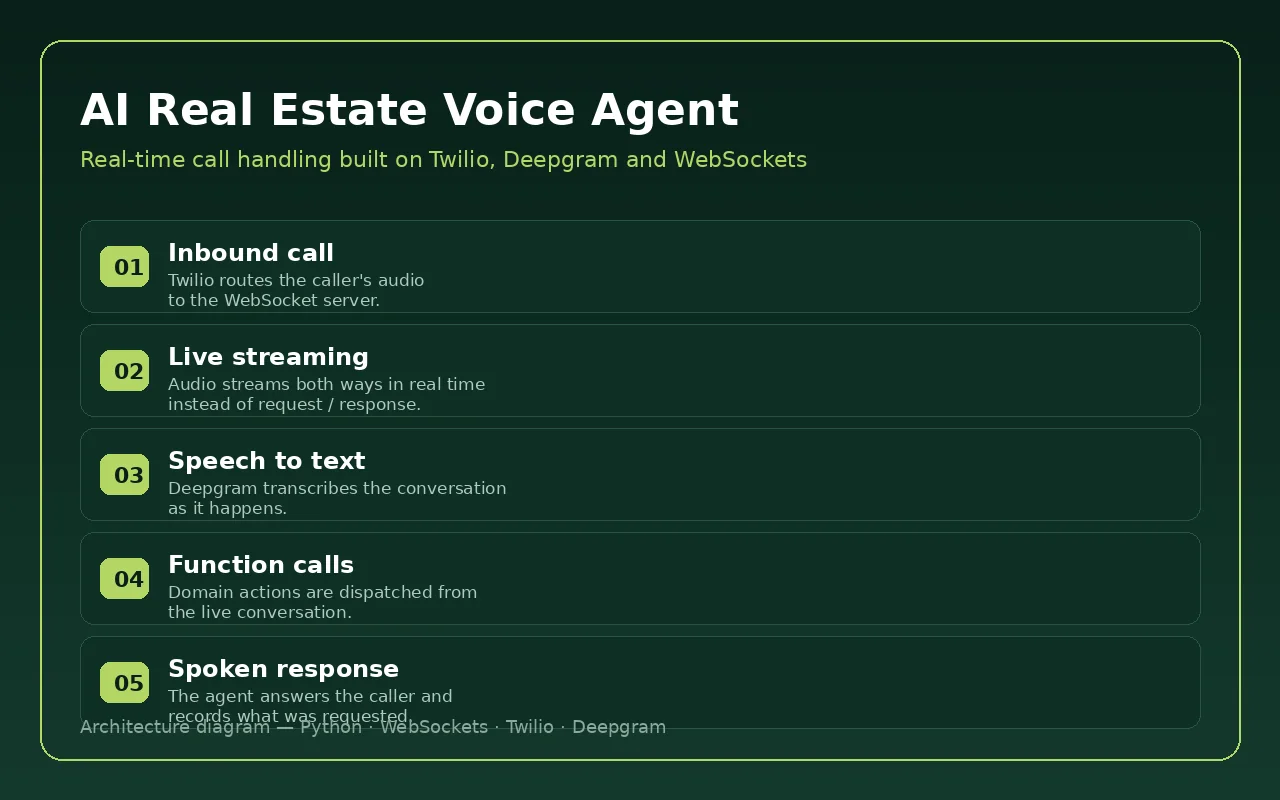
Architecture diagram based on the built integration — not a product screenshot.
01 — Overview
Project Overview
Property enquiries arrive as phone calls, and every call has to be answered by a person. This project explored what it takes to handle that conversation in software: keeping the audio flowing in real time, understanding what the caller is asking for, and triggering the action that enquiry needs. It is a working prototype rather than a deployed production service. The value of the project is the real-time pipeline, and the way conversation logic is kept separate from the provider integrations.
02 — Challenge
Business Challenge
Calls Need a Person
Every enquiry has to be picked up live, which limits how many can be handled.
Repetitive Questions
The same property and availability questions come up on most calls.
Real-Time Constraints
Streaming call audio cannot be handled like a request and a response.
03 — Solution
Our Solution
Streamed Call Audio
Twilio forwards the caller's audio to a WebSocket server as it happens.
Live Transcription
Deepgram converts the streamed speech to text so the agent can act on it.
Function-Call Dispatch
Property-specific actions are triggered from the live conversation.
Modular Integrations
Providers and workflows are kept separate so either can be replaced.
Testable Locally
A tunnelled endpoint makes the WebSocket call flow testable during development.
Clear Extension Point
New property automations are added as functions, not rewrites.
04 — Stack
Technology Stack
Python
WebSockets
Twilio
Deepgram
Speech-to-Text
Function Calling
ngrok (development)
Async Streaming
05 — Benefits
Potential Business Benefits
24/7 Customer Support
Faster Response Times
Lower Operational Costs
Consistent Customer Experience
Improved Lead Capture
Scalable Communication
06 — Engineering
Engineering Notes
07 — Start here
Interested in AI Voice Automation?
If you want to explore real-time voice automation for your business, we're happy to talk through what it would take — what is genuinely achievable today, and what the running costs and constraints look like.